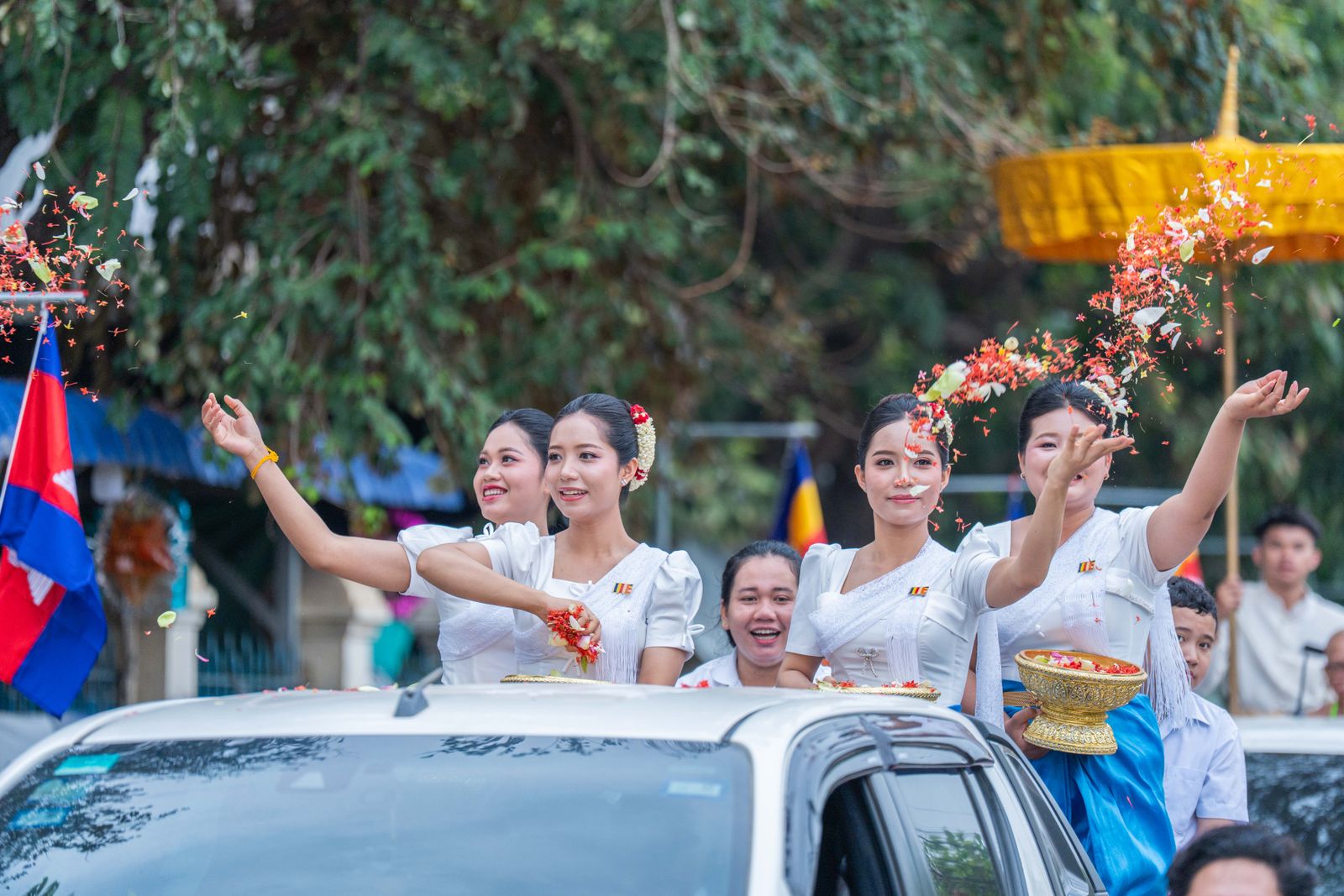
Cambodia’s calendar runs on two systems at once — the Gregorian calendar for everyday business, and a lunar one for the festivals that actually shape the year. The three biggest are Khmer New Year, Pchum Ben, and the Water Festival, and each one closes schools, empties cities, and fills the roads as Cambodians travel home to their home province. Visiting during one is a genuinely different experience from visiting any other week — but only if you understand what’s actually happening.
Khmer New Year (Choul Chnam Thmey)
What it is: Khmer New Year — Choul Chnam Thmey, literally “entering the new year” — is Cambodia’s biggest and most important holiday: a three-day national holiday in mid-April marking the end of the harvest, the turn of the traditional solar new year, and the single largest mass homecoming of the Cambodian calendar, as millions travel back to their home province. In 2026 it falls April 14–16; the exact dates are confirmed annually by the Ministry of Royal Palace, since they shift slightly from year to year.
Unlike a single midnight countdown, Choul Chnam Thmey unfolds over three distinct days, each with its own name and purpose — and the whole holiday is built on a Brahmanic legend that predates Buddhism’s arrival in Cambodia.
The Meaning Behind Choul Chnam Thmey: The Legend of the Seven Daughters
The story goes that a brilliant boy named Thommabal Komar mastered the sacred Vedas by age seven and could understand the language of animals. Hearing of his fame, the King of the Gods, Kabil Maha Prum, challenged him to answer three riddles within a week — what brings people happiness in the morning, the afternoon, and the evening — with his own head staked on the answer. Thommabal solved them only by overhearing two vultures discuss it: happiness comes from washing one’s face each morning, bathing to cool off in the afternoon, and washing one’s feet at the end of the day’s work.
Having lost, Kabil Maha Prum kept his promise and cut off his own head — but it was too sacred to touch the earth, fall into the sea, or hang in open air, since any of the three would have destroyed the world. So he gave it to his eldest daughter, Tungsa Devi, who carried it around the cosmic Mount Someru before sealing it inside a heavenly cave. Every year since, one of his seven daughters — a different “Tevada,” or new year angel — descends to carry the head in procession around Mount Someru once more before returning it to its resting place. Which daughter takes her turn, and what she rides, is published each year as an omen for the months ahead — which is why New Year posters and pagoda displays often show a serene young woman holding a tray bearing a severed head. It isn’t a horror reference; it’s the central image of the holiday.
The Three Days of Khmer New Year
- Maha Songkran (Day 1) — the turning point itself. Families clean and decorate the home, lay out fruit, candles, and incense on a household altar to welcome the incoming Tevada, and visit the pagoda to bathe Buddha statues in scented water as an act of purification.
- Virak Wanabat (Day 2) — the day of giving. Cambodians make merit by donating food and money to monks and to the poor, and many families build small mounds of sand at the pagoda — sometimes shaped into a stupa — as an offering dedicated to deceased ancestors.
- Virak Leang Sak (Day 3) — the closing ritual and, traditionally, the official start of the new year. Younger generations formally bathe their grandparents and parents in scented water, ask forgiveness for the past year’s mistakes, and receive blessings in return — a clean slate enacted between family members, not just spoken.
Only once this religious core is complete does the part most visitors actually see — the water fights, the street parties, the games — take over.
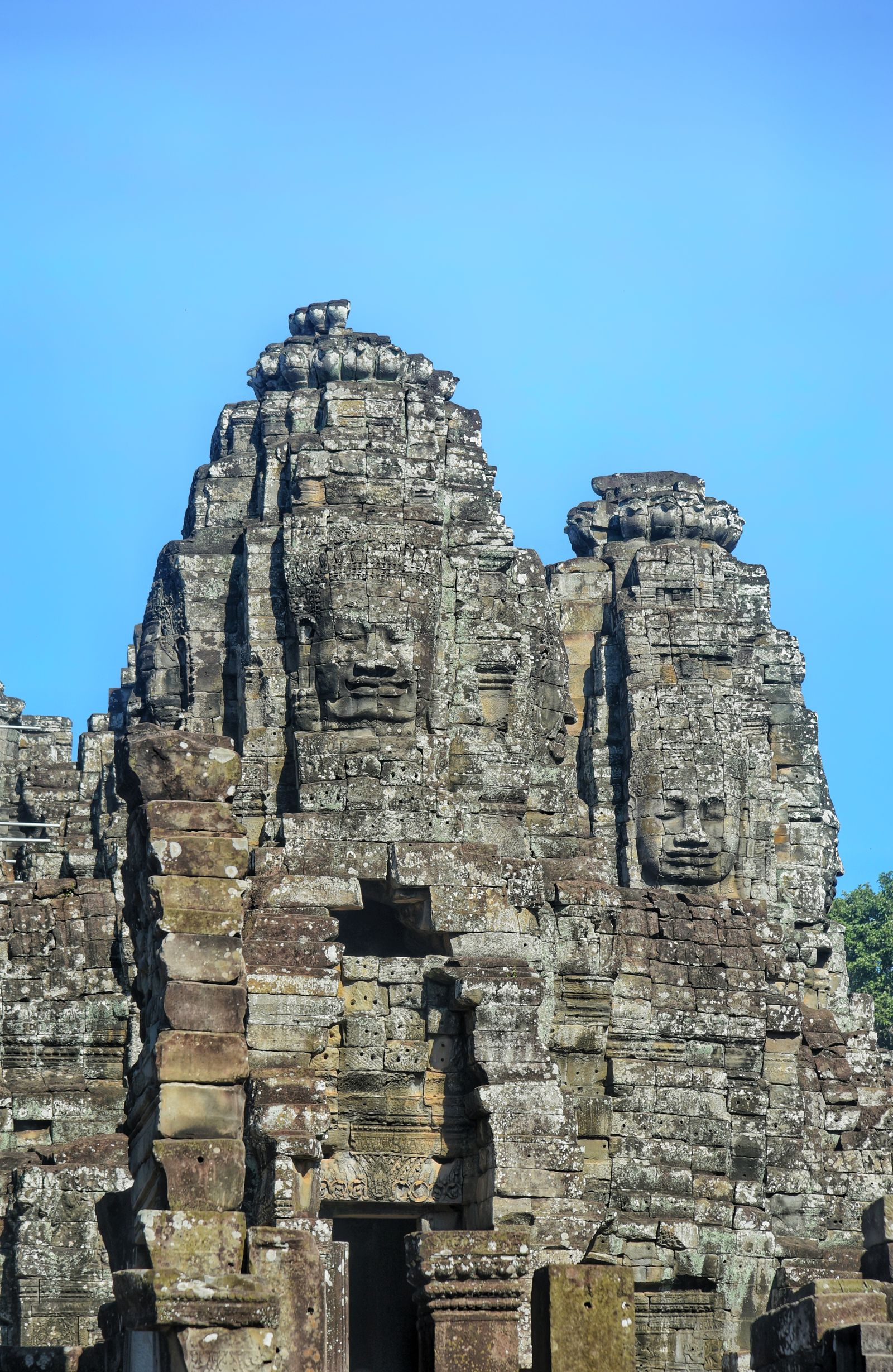
Where to celebrate it: Siem Reap and Phnom Penh both hold large public celebrations, but the most authentic version happens at neighbourhood pagodas (wats) anywhere in the country, where families bring food offerings and pray together. Angkor Wat itself hosts an “Angkor Sangkranta” cultural festival timed to the holiday, with traditional games and performances on the temple grounds.
How to celebrate it:
- Visit a local wat on Maha Songkran or Virak Leang Sak to see families bathing Buddha statues and lighting incense for ancestors
- Join in (or simply watch) water-throwing and powder fights in the streets — a playful echo of the purification rituals at the pagoda, now a city-wide, all-ages water fight, especially in the days after the formal holiday
- Try the festival’s signature dishes: num ansom (sticky rice cake steamed in banana leaf) and kralan (sticky rice and beans cooked inside bamboo), traditionally made by families together in the lead-up to the holiday
- Expect traditional games — tug-of-war, Cambodian hopscotch (leak kanseng), and Angkunh, a seed-throwing game played in mixed circles of friends and family that doubles as informal courtship
Good manners: If you get pulled into a water fight, that’s a sign of welcome, not hostility — a plastic bag over your phone is the practical move, not opting out entirely. At the pagoda itself, dial it right back: cover shoulders and knees, remove your shoes before entering a shrine, and keep your voice down around anyone praying or pouring water over a Buddha statue.
Pchum Ben (Ancestors’ Day)
What it is: A 15-day period of remembrance, usually falling in September or October, when the souls of ancestors are believed to return to the world of the living. Families believe the dead’s fate after this period is shaped by the offerings made on their behalf — making this one of the most spiritually significant stretches of the Cambodian year, even though it draws far fewer foreign visitors than Khmer New Year.
Where to see it: Every pagoda in the country, but particularly atmospheric at well-known temples like Wat Phnom in Phnom Penh or any working wat in Siem Reap, Battambang, or Kampot — look for crowds bringing food at dawn.
How to take part respectfully: Pchum Ben is built around dawn visits to pagodas, where families offer rice and food to monks, who in turn are believed to pass blessings on to deceased relatives. Visitors are welcome to observe quietly from a respectful distance; this is not a festival built around tourist participation the way Khmer New Year’s water fights are.
Good manners: Pchum Ben is solemn, not celebratory — keep a low profile, dress modestly, and avoid treating dawn temple visits as a photo opportunity. Many businesses close and many Cambodians travel to their home province during this period, so expect quieter cities and busier rural roads.
Bon Om Touk (Water Festival)
What it is: A three-day festival in November marking the reversal of the Tonle Sap River’s flow and the end of the rainy season, centred on boat races on the rivers of Phnom Penh.
Where to see it: Phnom Penh’s riverfront is the main stage, with long, narrow racing boats crewed by dozens of rowers competing in front of huge crowds along Sisowath Quay.
How to take part: Simply join the riverside crowds — this is a public spectator festival, with food stalls and a carnival atmosphere along the river for its duration.
Good manners: Crowds are dense and security is tight given a tragic crowd-crush incident in 2010 — stay aware of crowd flow and follow any official crowd-control direction.
Cambodia Festivals & Events Calendar
| Festival | Timing | What it marks |
|---|---|---|
| Khmer New Year (Choul Chnam Thmey) | April (14–16 in 2026) | End of harvest, start of the lunar new year |
| Royal Ploughing Ceremony | May | Ceremonial start of the rice-growing season |
| Pchum Ben (Ancestors’ Day) | September/October | A 15-day period honouring deceased ancestors |
| Bon Om Touk (Water Festival) | November | End of the rainy season, Tonle Sap’s flow reversal |
For seasonal travel planning around these dates — crowd levels, road closures, and what’s actually open — see the full month-by-month breakdown on our best time to visit Cambodia guide.
The One Rule That Covers All of Them
Whatever the festival, the same baseline applies: dress modestly at any pagoda, never touch a monk if you’re a woman, remove your shoes before stepping onto a shrine’s raised floor, and ask before photographing anyone mid-ritual. Cambodians are typically warm about including visitors in the louder, public-facing parts of these festivals — it’s the quieter, religious core of each one that calls for restraint rather than a camera.
Related Articles


CambodiaGo Editorial
cambodiago.com Editorial
Ready to Visit Cambodia?
Browse itineraries, destinations, and everything you need to plan your trip.