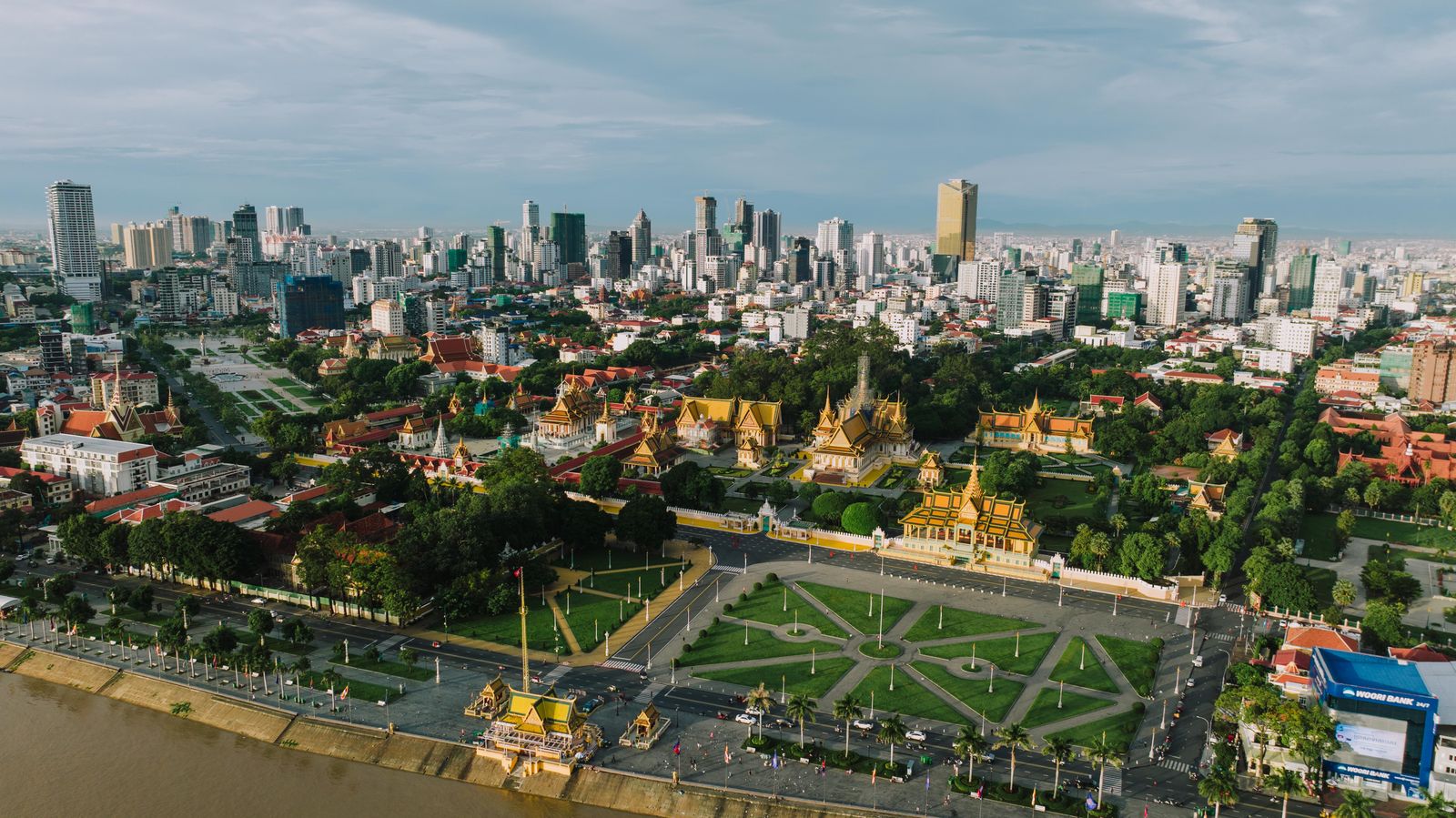
Most visitors treat Phnom Penh as a stopover between Siem Reap and the coast — a night or two before moving on. That’s a mistake. Cambodia’s capital has enough packed into a compact, walkable riverside core to fill two full days: a working royal palace, the country’s most important (and most difficult) modern history, a market that rewards a slow wander, and a street food scene that genuinely rivals Bangkok’s.
Here’s how to do it properly in 48 hours.
Day 1, Morning: The Royal Palace and Silver Pagoda
Start early — by 7:30am if you can — both to beat the heat and the tour buses. The Royal Palace complex, built in 1866 when the capital moved here from Oudong, is still the working residence of the King of Cambodia, so parts of it are closed to visitors, but the Silver Pagoda (Wat Preah Keo) inside the grounds is open and extraordinary: over 5,000 silver floor tiles, a life-sized gold Buddha set with 9,584 diamonds, and an Emerald Buddha carved from Baccarat crystal.
Practical details: entry is $10, open 8am–11am and 2pm–5pm (it closes for lunch, plan around it), and the dress code is strict — covered shoulders and knees, no exceptions, even though this isn’t a religious site in the same sense as Angkor’s temples. Sarongs are sold at the gate if you arrive unprepared.
Allow 90 minutes, then walk five minutes south along the riverfront to the National Museum of Cambodia — the terracotta building you’ll have already noticed — for the best collection of Khmer sculpture outside the Guimet in Paris. An hour is enough unless you’re genuinely into Angkorian art history.
Day 1, Afternoon: Tuol Sleng and the Killing Fields
This is the hardest few hours of any Cambodia trip, and also the most necessary. Tuol Sleng (S-21) was a high school converted into the Khmer Rouge’s main interrogation centre between 1975 and 1979; it’s now a genocide museum, largely unchanged, with classrooms still holding torture equipment and walls of photographs of the people held there. Choeung Ek, the “Killing Fields” memorial 17km outside the city, is where most of S-21’s prisoners were ultimately executed.
Visiting both in one afternoon is heavy — some travellers prefer to split them across two days, or do only one. If you only have time for one, most people find Tuol Sleng more affecting because of its proximity to the city and the rawness of being inside the actual building. Both sites have excellent audio guides ($3–5) included or near the ticket price; use them. Hire a tuk-tuk for the half-day ($15–20 round trip including waiting time at Choeung Ek) rather than trying to coordinate transport yourself.
A note on dignity: these are sites of mass atrocity within living memory — many guides and staff are survivors or relatives of victims. Photography is permitted in most areas but be quiet, be respectful, and resist photographing other visitors’ reactions.
Day 1, Evening: Sisowath Quay at Sunset
After an afternoon like that, the riverfront is exactly the reset you need. Sisowath Quay, the promenade running along the Tonle Sap, fills up every evening with families, badminton games, fruit-shake carts and groups doing aerobics to blaring speakers — it’s one of the best free people-watching spots in Southeast Asia. Grab a beer at one of the riverside bars (the rooftop at Le Moon, above the FCC building, has the best sunset angle over the confluence of the Mekong and Tonle Sap rivers) or book a sunset river cruise ($8–15 for an hour, boats leave roughly every 20 minutes from the public dock).
For dinner, walk a block inland to Street 240 or Bassac Lane for a concentration of good small restaurants and bars in old shophouses — far less touristy than the riverfront strip itself.
Day 2, Morning: Markets and Local Life
Spend your second morning at Phsar Thmei (the Art Deco “Central Market” with its distinctive yellow dome, good for jewellery and souvenirs) or, better, the Russian Market (Phsar Toul Tom Poung) further south — narrower, hotter, far less polished, and genuinely interesting: old film cameras, motorbike parts, pirated DVDs, and a back corner of garment-factory overstock from the brands that manufacture here. It’s also one of the best lunch spots in the city — the food stalls ringing the market’s edges serve some of the cheapest, best Khmer food you’ll find anywhere.
Bargain, but gently — Cambodian market culture rewards good humour over hard tactics, and the amounts at stake are rarely more than a dollar or two.
Day 2, Afternoon and Evening: Wat Phnom and the Night Market
Round out the trip with Wat Phnom, the small hilltop temple that gives the city its name (“Hill Temple”), 20 minutes’ walk from the centre — modest compared to Angkor, but a good half-hour stop and a popular spot with local people coming to pray and buy fortune-telling birds released for good luck. From there, it’s a short tuk-tuk to the Phnom Penh Night Market near the riverside (open Friday–Sunday evenings), with mat-seating food courts, cheap clothes stalls and the best people-watching of the trip.
For a final dinner, Romdeng — a training restaurant for former street youth, serving Khmer specialties including the famous (if intimidating) deep-fried tarantula — is a genuinely good meal as well as a place that puts your money somewhere useful.
Frequently Asked Questions
Is two days enough for Phnom Penh? Yes, for the essential sights. Two days lets you do the Royal Palace, the genocide sites, and a market or two without rushing. A third day is worth adding if you want to take a day trip to Koh Dach (Silk Island) or slow the pace down.
Is Phnom Penh safe to visit? Yes, for the vast majority of visitors. Standard city precautions apply — watch for bag-snatching from passing motos on the riverfront at night, and use registered taxis or Grab/PassApp after dark rather than unmarked tuk-tuks.
Should I visit Tuol Sleng and the Killing Fields on the same day? It’s possible but emotionally heavy. If you have a third day available, splitting them gives you space to process each separately.
How do I get around Phnom Penh? Tuk-tuks and the Grab/PassApp ride-hailing apps cover everything. The city is too spread out and too hot to walk between sights, though the riverfront area itself is very walkable.
What’s the best way to get from Phnom Penh to Siem Reap or the coast afterward? Buses (5–6 hours to Siem Reap, 3–4 hours to Sihanoukville) are cheap and reliable; domestic flights to Siem Reap take 45 minutes if you’d rather not spend the day on the road.
Related Articles

Sophea Rithy
Southeast Asia specialist. 7 years living in Phnom Penh.
Ready to Visit Cambodia?
Browse itineraries, destinations, and everything you need to plan your trip.